
Rideshare Accident Lawyer Salt Lake City, UT
Being injured in a rideshare collision involving Uber or Lyft presents a uniquely complex insurance situation. Determining which policy applies, the driver’s personal coverage, the rideshare company’s commercial policy, or a third party’s insurance, depends on the driver’s precise status within the app at the moment of the accident. Rideshare companies have designed these multi-layered insurance structures in ways that often obscure liability and complicate the claims process.
At the same time, injured individuals are contending with mounting medical expenses, physical recovery, and potential loss of income. Navigating overlapping insurance frameworks should not fall on the shoulders of someone already dealing with the consequences of another party’s negligence.
Acadia Law Group has represented Utah accident victims for more than 25 years. Our rideshare accident lawyer in Salt Lake City, UT has extensive experience with the insurance structures unique to rideshare cases and works to ensure that clients receive the compensation they are owed. We handle these cases on a contingency-fee basis, meaning you owe no legal fees unless we secure a recovery on your behalf. If you have been injured in a rideshare accident, contact our office for a free consultation.
Why Choose Acadia Law Group for Rideshare Accident Cases in Salt Lake City, Utah?
Experienced Legal Representation You Can Trust
Attorney Kenneth Denos founded Acadia Law Group and has been practicing law since 1998. He earned his Juris Doctor from the University of Utah S.J. Quinney College of Law and holds additional graduate credentials, including an MBA and degrees in finance and political science. He has been an active member of the Utah State Bar for more than 25 years.
Rideshare accident claims differ significantly from standard motor vehicle collision cases. Companies like Uber and Lyft have invested considerable resources into legal and corporate frameworks designed to limit their financial exposure. They classify drivers as independent contractors rather than employees, maintain tiered insurance policies that shift based on the driver’s app status at the time of the accident, and retain dedicated legal teams focused on minimizing claim payouts.
Effectively pursuing a rideshare injury claim requires an attorney who understands these corporate structures and knows how to hold these companies accountable. Attorney Denos has represented thousands of clients throughout his career, including cases involving well-resourced defendants that actively resist paying fair compensation.
If you are searching for a personal injury lawyer in Salt Lake City, UT following a rideshare accident, Acadia Law Group provides the dedicated, knowledgeable representation these cases demand.
A Track Record of Getting Results
Acadia Law Group has recovered millions of dollars for injury victims across all kinds of cases. What happened before doesn’t guarantee what happens in your case, but it shows we know how to get fair compensation when insurance companies are trying to lowball you.
You Don’t Pay Unless We Win
We work on contingency. No hourly rates, no retainers, no upfront costs. If we don’t recover money for you, you owe us nothing. Rideshare accident victims are already stressed about medical bills and time off work. Worrying about legal fees shouldn’t be part of that.
What Our Clients Say
⭐⭐⭐⭐⭐
“Acadia Law Group was incredibly helpful and professional throughout my case. They communicated clearly, kept me updated, and truly cared about the outcome. Highly recommend their team!” – Lia Buenrostro
Read more reviews on our Google Business Profile.
Types of Rideshare Accident Cases We Handle in Salt Lake City
Rideshare wrecks happen in all kinds of ways, and the insurance situation changes depending on the circumstances.
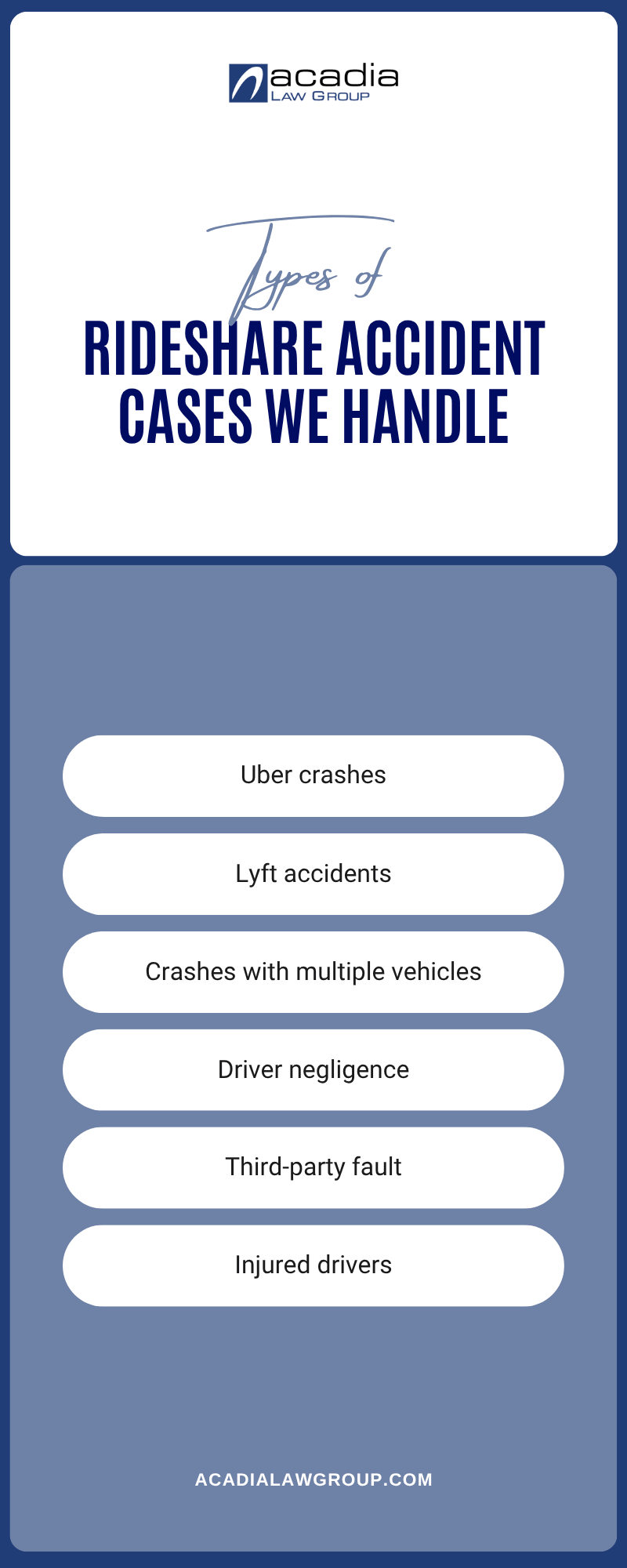
- Uber crashes. If you were a passenger when your Uber got hit, you’re probably covered by Uber’s $1 million policy. But if you were in another car and an Uber driver hit you, whether that policy applies depends on what the driver was doing with the app. Was the app on? Were they waiting for a ride request? Heading to pick someone up? On an active trip? Each status triggers different coverage.
- Lyft accidents. Lyft uses basically the same insurance structure as Uber. Same tiered system, same questions about what the driver was doing when the crash happened. Getting that information can be tricky because the companies don’t hand it over willingly.
- Crashes with multiple vehicles. Some rideshare accidents involve the Uber or Lyft, another driver, maybe a pedestrian or cyclist. When multiple people share fault, figuring out who pays what gets complicated fast. You might have claims against several insurance policies at once.
- Driver negligence. Rideshare drivers are often tired, distracted by the app, unfamiliar with the area, or rushing to pick up their next passenger. All of that creates risks. When a driver’s carelessness causes a crash, both their personal liability and the rideshare company’s coverage may come into play.
- Third-party fault. Sometimes a rideshare passenger gets hurt because some other driver ran a red light or rear-ended the Uber. In those situations, you’ve got claims against the at-fault driver’s insurance, plus potentially the rideshare company’s underinsured motorist coverage if that’s not enough.
- Injured drivers. If you’re a rideshare driver who got hurt on the job, your situation is complicated. Personal auto insurance usually excludes commercial driving. The rideshare company’s policies have gaps. Figuring out who covers what takes careful analysis.
Utah Legal Requirements for Rideshare Accident Claims
 Utah has specific rules about rideshare insurance, and knowing how they work affects what you can recover.
The Insurance Layers
Under Utah Code § 13-51-107, rideshare companies have to carry certain minimum insurance, but the amounts depend on what the driver’s doing:
App on, no ride accepted yet: $50,000 per person, $100,000 per accident for injuries, plus $25,000 for property damage. Not a lot of coverage if you’re seriously hurt.
Ride accepted through trip completion: $1 million combined coverage, plus uninsured/underinsured motorist protection. This is the big policy that kicks in when passengers are on board or the driver’s heading to pick them up.
The difference between these tiers matters a lot. A driver scrolling for ride requests has much less coverage than one with a passenger in the car. Proving exactly where in the cycle the driver was at the time of the crash becomes critical.
Time Limits
Utah Code § 78B-2-307 gives you four years to file a personal injury lawsuit. That sounds like plenty of time, but don’t wait. Rideshare companies may have their own internal deadlines for reports and claims. Evidence disappears. Witnesses forget what they saw. Start the process sooner rather than later.
Shared Fault
Utah uses a modified comparative fault rule under Utah Code § 78B-5-818. If you’re partly responsible for the accident, your compensation gets reduced by your percentage of fault. But if you’re 50% or more at fault, you get nothing. Insurance adjusters love to argue that you share blame. We push back on that.
What Damages Are Recoverable in Salt Lake City Rideshare Accident Cases?
What you can recover depends on how badly you’re hurt and how the crash affected your life.
The Concrete Costs
Medical bills pile up fast after an accident. ER visits, ambulance rides, surgery, physical therapy, follow-up appointments, imaging, prescriptions. Rideshare crashes range from fender benders to catastrophic collisions. Whatever treatment you need, those costs are recoverable.
Lost wages count too. If you missed work while recovering, that’s money you should get back. If your injuries keep you from returning to your old job, or from working at all, future lost earnings become part of the calculation.
Then there are the smaller costs that add up. Parking at the hospital. Gas to get to appointments. Hiring someone to help around the house while you recover. Replacing damaged property.
The Harder-to-Measure Harm
Pain is real, even if you can’t hand someone a receipt for it. The discomfort from your injuries, during treatment, through recovery. That deserves compensation.
Car accidents mess with people psychologically too. Anxiety about getting in vehicles again. Flashbacks. Trouble sleeping. Fear when you’re near traffic. Some people develop full-blown PTSD. The emotional toll of a crash is just as real as the physical injuries.
And there’s the life stuff you lose. Maybe you used to hike every weekend, and now you can’t. Maybe you played in a basketball league and your knee doesn’t work right anymore. That loss of enjoyment matters.
Punitive Damages
These are rare in rideshare cases, but if the driver was drunk, high, or doing something outrageous, punitive damages might be on the table. They’re meant to punish particularly bad behavior and send a message.
What Steps Should I Take After a Rideshare Accident in Salt Lake City?
What you do right after a rideshare crash makes a difference for both your health and your legal case.
- Make sure you’re safe. If you can move without making injuries worse, get away from traffic. Check on other people involved.
- Call 911. Get police and EMS to the scene. The police report becomes important evidence later.
- Screenshot your trip info immediately. Before you close the app, screenshot everything: trip details, driver name and photo, vehicle info, the route. If there’s an in-app crash report screen, screenshot that too. This information can be hard to get later.
- Take pictures of everything. The vehicles, the damage, the intersection, skid marks, traffic signals, your injuries. Take more photos than you think you need.
- Get witness contact info. Other passengers, people who saw the crash happen, anyone who stopped to help. Their testimony could matter.
- See a doctor. Even if you feel okay, get checked out. Some injuries take hours or days to show symptoms. A medical record from right after the crash also helps establish that your injuries came from the accident.
- Report through the app, carefully. Uber and Lyft both have in-app accident reporting. Do it, but watch what you say. That report goes to their insurance people, and they’ll use your own words against you if they can.
- Get the police report. Follow up in a few days and request a copy. It documents what the investigating officer found.
- Don’t give recorded statements without legal advice. Multiple insurance companies will probably contact you. The rideshare company’s insurer, the other driver’s insurer, maybe your own. They all have their own interests, and those interests aren’t aligned with yours. Don’t give detailed statements until you’ve talked to an attorney.
- Call a rideshare accident lawyer. These cases are complicated. Multiple policies, tiered coverage, corporate liability questions. A Salt Lake City Uber and Lyft accident attorney can figure out all the insurance that applies and go after full compensation.
Salt Lake City Rideshare Accident Infographic
Rideshare Accident Statistics in Salt Lake City
 The numbers tell an interesting story about rideshare safety.
The National Bureau of Economic Research found that rideshare services led to more vehicle miles traveled in cities where they operate. More cars on the road means more accidents. That’s just math.
The National Highway Traffic Safety Administration tracks traffic deaths but doesn’t break out rideshare-involved crashes separately in national data. Still, studies have tried to measure the impact. Research out of the University of Chicago found that rideshare services were associated with a 2-3% increase in traffic fatalities in major metro areas. That’s thousands of additional deaths nationwide.
The Insurance Institute for Highway Safety has pointed out that managing rideshare apps while driving creates distraction risks. Drivers are checking for ride requests, navigating to pickups, rating passengers. All of that takes attention away from the road.
Uber has published safety reports acknowledging thousands of crashes involving their drivers each year. It’s not a secret that rideshare driving carries risks.
Salt Lake City follows national trends. The airport generates constant rideshare traffic. Downtown entertainment brings out Ubers and Lyfts every weekend night. The University of Utah area sees heavy student use. According to the Utah Department of Public Safety, Salt Lake County has tens of thousands of vehicle crashes annually, and rideshare vehicles are involved in a portion of those.
Salt Lake City Rideshare Accident Lawyer FAQs
Who’s responsible when a rideshare crashes?
It depends. If the rideshare driver caused the wreck, both the driver and the company’s insurance may apply. If another driver caused it, their insurance is primary. Sometimes multiple parties share fault. We sort out who owes what.
How does rideshare insurance actually work?
It’s tiered. When the app is off, only the driver’s personal insurance matters. When the app is on but no ride is accepted, there’s limited commercial coverage. During active trips, the $1 million policy kicks in. Figuring out which tier applies is half the battle.
I was a passenger in the Uber that crashed. What are my options?
Passengers usually have strong claims. You weren’t driving, so you’re not at fault. The rideshare company’s insurance should cover you when the driver was on an active trip. We make sure you get what you’re entitled to.
Another car hit the Uber I was riding in. Now what?
You probably have claims against multiple policies. The at-fault driver’s insurance. The rideshare company’s underinsured motorist coverage if that’s not enough. Maybe your own auto insurance too. We identify everything that applies.
What does it cost to hire you?
We work on contingency. No upfront fees. We get paid only if we recover money for you.
How long do I have to file a claim?
Utah gives you four years for personal injury lawsuits. But rideshare companies have their own internal deadlines for various reports and claims. Don’t wait too long to get legal advice.
Should I report the accident through the Uber or Lyft app?
Yes, report it. But be careful what you say. Anything you write goes to the company’s insurance people, and they’ll use your own statements against you later. Keep it factual and brief.
What if the driver was on their phone?
Distraction from app use is a common factor in rideshare crashes. It helps prove the driver was negligent. We investigate what the driver was doing before and during the crash.
Can I actually sue Uber or Lyft directly?
They’ve set things up to make that hard. They call drivers independent contractors, not employees, specifically to avoid direct liability. But their insurance policies are designed to cover passengers and third parties. In some situations, direct claims against the company are possible.
How much could my case be worth?
It depends on your injuries, your medical bills, your lost income, how the crash has affected your life. The $1 million policies available during active trips can cover serious injuries. We evaluate everything during a free consultation.
I’m a rideshare driver and I got hurt. What are my options?
This gets complicated. Personal auto insurance usually excludes commercial use. Rideshare company coverage has gaps. Workers’ comp doesn’t apply because you’re a contractor. We look at every possible source of recovery.
What evidence do I need?
Screenshots of your trip info, the police report, witness statements, medical records, photos from the scene, and the driver’s app data showing their status when the crash happened. The more you have, the better.
How long will my case take?
Hard to say. Multiple insurance policies and potential defendants can drag things out. Some cases settle in a few months. Complex ones take longer. Case duration depends on specific circumstances.
What if the driver was running multiple rideshare apps at once?
Some drivers have Uber and Lyft going simultaneously, accepting whoever pings them first. This can create coverage questions and potentially multiple sources of insurance. We figure out how to navigate that.
Can pedestrians or cyclists sue rideshare drivers?
Absolutely. If a rideshare driver hit you while you were walking or biking, you have claims against the driver and potentially the rideshare company’s insurance, depending on the driver’s app status.
Most Dangerous Areas for Rideshare Accidents in Salt Lake City
 Some parts of Salt Lake City see way more rideshare activity than others, and that concentration creates accident hotspots.
Downtown gets heavy rideshare traffic, especially around Main Street, 200 South, and the City Creek area. After work and on weekend nights, the streets fill with Ubers and Lyfts.
The airport is constant. Pickups, dropoffs, drivers waiting in the lot. Terminal Drive and the airport access roads see vehicle conflicts all day.
University of Utah campus draws a lot of student rideshare use. South Campus Drive and Foothill Drive get busy, particularly on weekends and around events.
The Gateway and Vivint Arena pack in rideshares before and after events. Concerts and Jazz games mean surge traffic in a small area.
Sugar House has restaurants and nightlife along 2100 South and Highland Drive that keep rideshares circulating through the evenings.
Temple Square and surrounding downtown attracts tourists who rely on rideshares to get around since they don’t know the city.
Important Local Resources for Salt Lake City Rideshare Accident Victims
These resources might help if you’ve been hurt in a rideshare crash. We’re listing them for your convenience, not as an endorsement.
Salt Lake City Police Department – (801) 799-3000. File accident reports and request copies.
Utah Highway Patrol – (801) 965-4518. Handles crashes on state highways and interstates.
University of Utah Hospital – (801) 581-2121. Level I trauma center for serious injuries.
Intermountain Medical Center – (801) 507-7000. Major hospital with emergency services.
Utah Insurance Department – (801) 538-3800. For complaints about insurance company behavior.
Uber Support – In-app and online accident reporting.
Lyft Support – In-app and online accident reporting.
Disclaimer: We’re providing this information for convenience only. Acadia Law Group doesn’t endorse these organizations.
Contact Acadia Law Group
If you got hurt in a rideshare accident in Salt Lake City, we can help you make sense of the insurance mess and get fair compensation. These cases are confusing by design. The companies have set them up that way. We know how to cut through it.
Consultations are free. We work on contingency, so you pay nothing unless we win.
Ken Denos has been fighting for injury victims throughout Utah for more than 25 years. We’ll figure out all the insurance that applies and go after what you deserve.
Contact us to set up your free consultation.